
Programmable drug-release from multicompartment microgel drug carrier systems
Our profile
Do you want to shape the next generation of sustainable and biocompatible smart soft polymer materials? Do you want to be part of a stimulating and supportive research environment and receive high-level training throughout your doctoral studies?
We offer a position in a tandem project of the DFG-funded graduate school Adaptive Soft Matter Through Programming Colloidal Gels with Biological Building Blocks (EMERGE) to develop compartmentalized polysaccharide microgels with programmed degradation for multi-step drug release.
Degradability is an essential property of sustainable polymer materials, especially for agricultural or biomedical applications. The degradation process is tightly connected to important material functions like chemical stability, mechanical strength, the hierarchical architecture and the release of active ingredients. Polysaccharides can be considered as alternatives to synthetic polymers to design microgel particles with programmed enzymatic degradation and high biocompatibility. However, to advance such microgels to superior self-immolative and on-demand drug-release carriers there is a need to embed further functionalities e.g. internally programmed, sustained or temporally administered release of multiple or incompatible drugs.
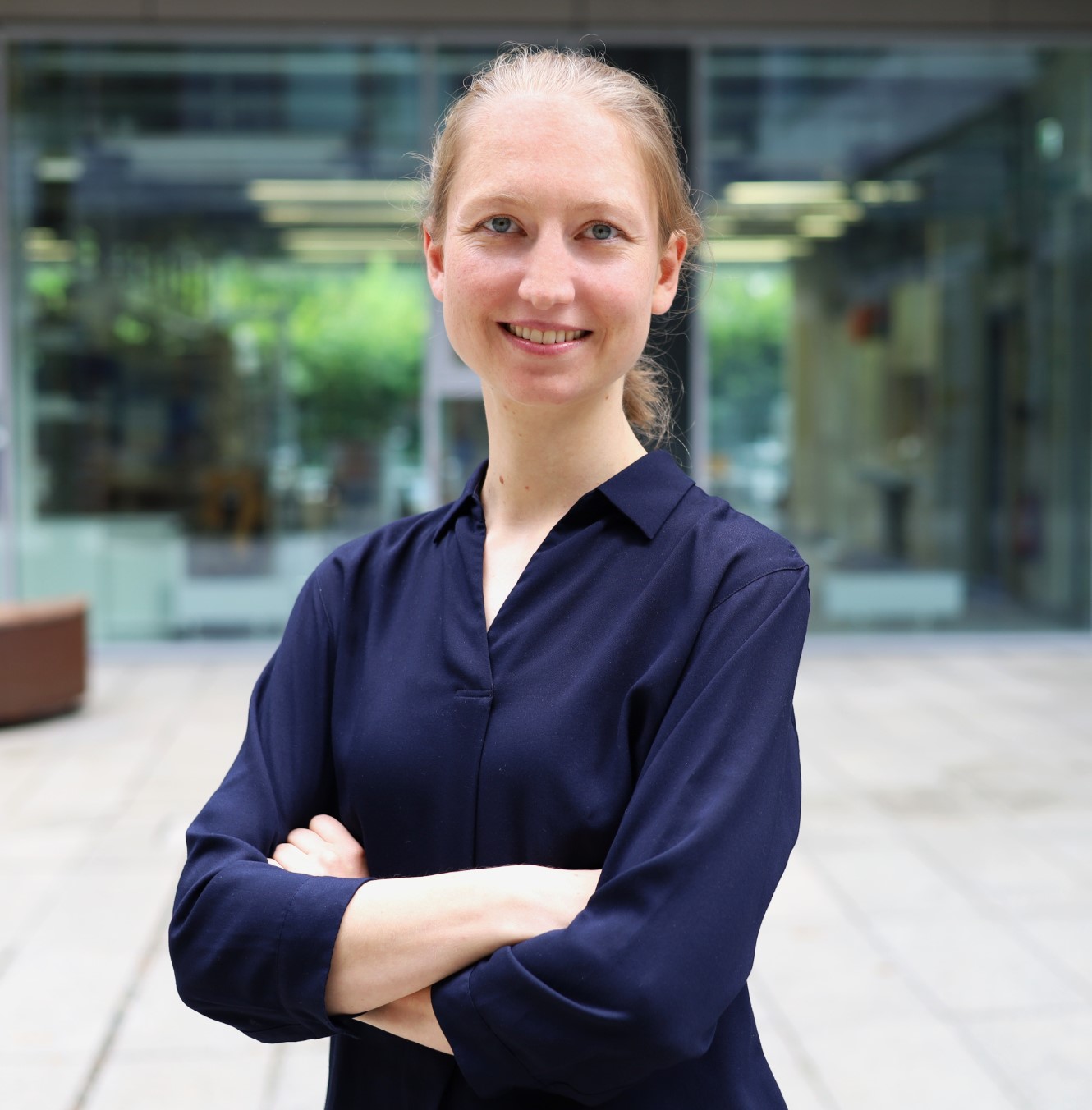
The position is placed at the research group of Dr. Laura Heinen at DWI – Leibniz Institute for Interactive Materials in Aachen – RWTH Campus Melaten.
The Heinen lab pursues an interdisciplinary research approach combining expertise from systems chemistry, synthetic biology and soft matter science to engineer active and life-like soft materials with hierarchical length and time scales.
The DWI – Leibniz Institute for Interactive Materials is equipped with state-of-the art infrastructure to allow top-notch interdisciplinary research at one place and is closely intertwined with RWTH Aachen University.
More information on this position.
Your tasks
You will be part of the DFG-funded graduate school Adaptive Soft Matter Through Programming Colloidal Gels with Biological Building Blocks (EMERGE). In project B1 - Programmable drug-release from multicompartment microgel drug carrier systems - your task will be to introduce self-instructed and programmed degradation into microgels by stepwise activation of internal sub-compartments. You will synthesize biodegradable and compartmentalized microgels and establish enzymatic assays to release active ingredients and control the degradation of the microgels. You will apply various microscopy techniques and spectroscopic assays to analyze in detail the morphology of the microgel particles and the release profiles during degradation.
The successful applicant must be accepted as a Natural Sciences (Dr. rer. nat.) candidate at RWTH Aachen University.
Your profile
You have quickly and very successfully completed your Master studies at a university in the field of e.g., chemistry, biochemistry, biotechnology, or comparable study programs.
You are routined in working in a research (wet) lab environment and are highly motivated to develop yourself into an accomplished and independent researcher personality. Ideally, you have already gained previous experience in basic polymer synthesis and/or biochemical enzymatic assays and reaction kinetics. You are creative, curious and team-oriented. You are communicative, open-minded and persistent. You have an accurate and independent work method and you love challenges.
You are fluent in written and spoken English. You intend to obtain a doctorate (Natural Sciences (Dr. rer. Nat.) on a challenging interdisciplinary topic.
Visit the following page to submit your application:
Please direct your application directly to Dr. Laura Heinen. Your application should contain your CV, a motivation letter, 1-2 reference contacts, and the certificates/transcripts of records of your recent degree programmes.