Laurin Poro Receives RWTH Speed Fund for a New Approach to Lung Wound Closure
A pneumothorax—the accumulation of air in the pleural space between the lung and the chest wall—is a potentially serious complication that can occur either spontaneously or as a result of invasive medical procedures. After the air has been removed, a key challenge remains: the injured lung tissue must be closed securely and permanently. Supporting tissue regeneration is also crucial in order to prevent long-term damage. In surgical treatment, mechanical closure methods such as surgical staples or surgical adhesives are commonly used. However, these approaches each have specific limitations regarding biocompatibility, biodegradability, and mechanical adaptability. Materials with improved biointegrative properties therefore remain the subject of intensive research.
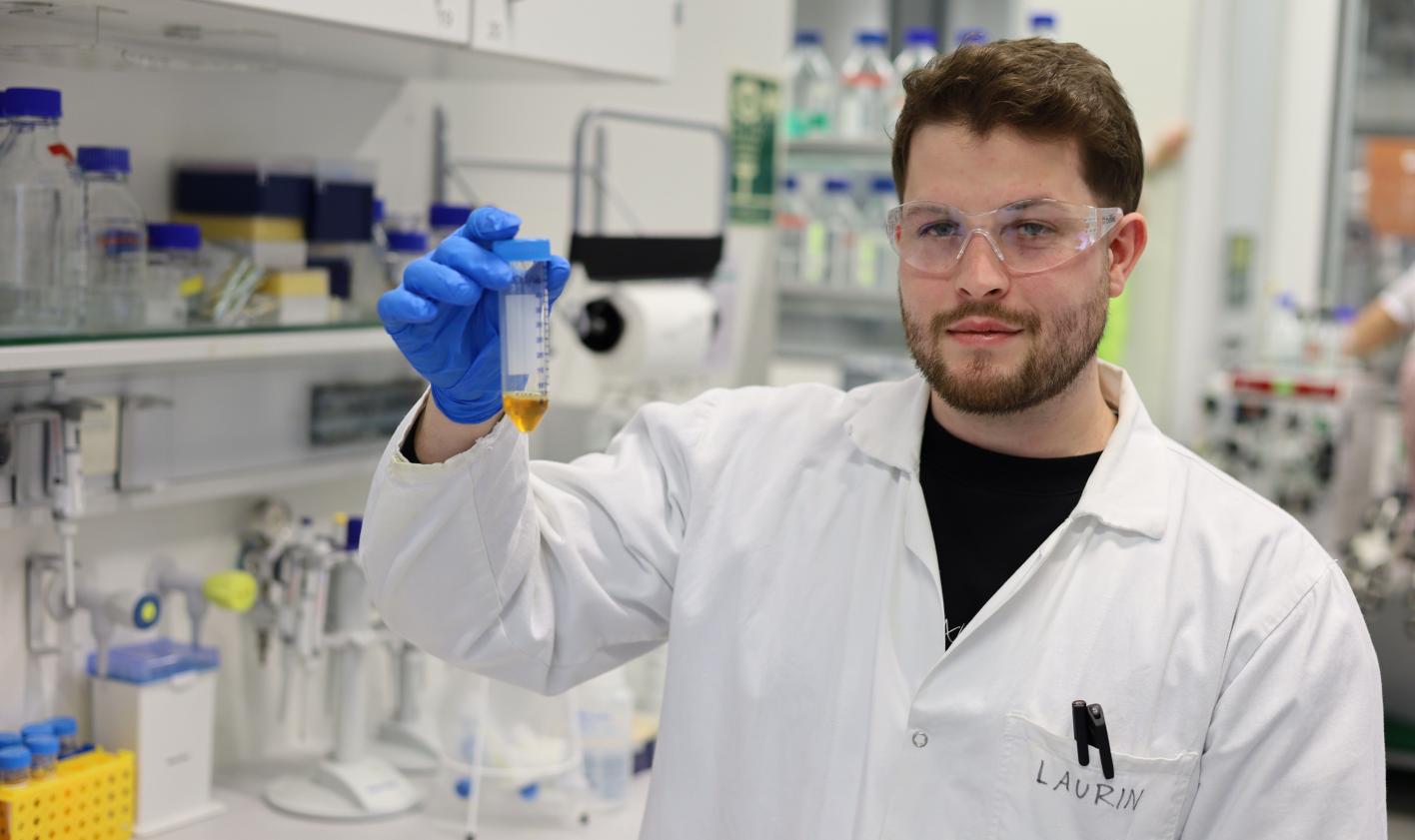
This is where Laurin Poro’s master’s thesis comes in. The aim is to develop a protein-based composite hydrogel that could serve as an alternative solution for lung wound closure. The system is based on negatively charged sugar beet pectin particles and positively charged polypeptide constructs coupled to self-assembling proteins. Electrostatic interactions lead to the formation of a three-dimensional network whose mechanical properties can be precisely tuned through modifications in the polypeptide sequence using protein engineering. In addition, the material is functionalized with bioactive peptide sequences to promote cell adhesion and actively support healing processes. Cell culture studies will further investigate how material properties and surface functionalization influence the behavior of human lung cells. If the development of a stable, biobased and biocompatible hydrogel succeeds, it could make an important contribution to improved solutions for lung wound closure.
Poro’s work is supervised by Julian Karl, a doctoral researcher at the DWI – Leibniz Institute for Interactive Materials and RWTH Aachen University. His research focuses on protein-based materials for biomedical applications, and he has co-developed the conceptual and experimental foundations on which the master’s thesis builds.
For this project, Laurin Poro has been awarded an RWTH Speed Fund. Around €15,000 are available to cover laboratory and material costs and to disseminate the results within the scientific community. The budget also includes participation in the annual conference of the German Society for Biomaterials, where results and ideas can be discussed with experts in the field.
The funding scheme is jointly supported by the RWTH profile areas and the Hans-Hermann-Voss Foundation. Its aim is to rapidly test innovative concepts experimentally and to increase their visibility through formats such as the “Profile Area Talent Talks”.